Sarah decided at 32 that she wasn’t waiting for a partner. Maya and Priya had been married for two years and were ready to start a family. Both paths led to the same first question: what does donor sperm IUI actually cost?
The answer is more layered than the quoted price suggests. You’re paying for the sperm itself, the IUI procedure, monitoring if needed, and potentially several cycles. Here’s the full breakdown.
What You’re Actually Paying For
Donor sperm IUI involves three separate cost buckets:
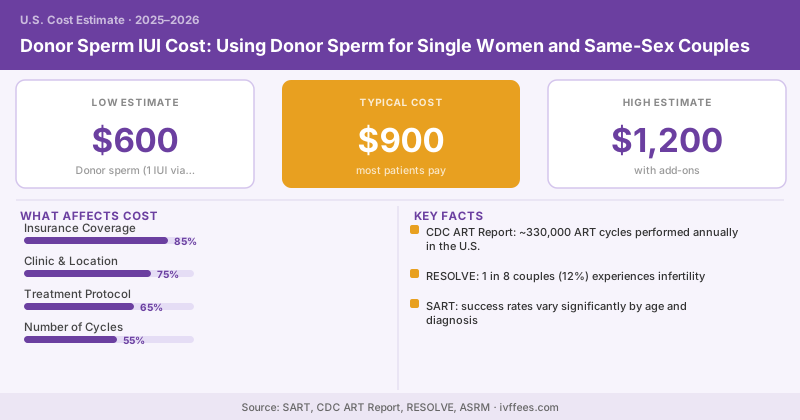
1. Donor sperm purchase. You select a donor from a sperm bank, purchase one or more vials, and have them shipped to your RE’s office or fertility clinic. Sperm banks in the U.S. typically charge $600 to $1,200 per vial for IUI-ready (IUI-washed) specimens.
2. IUI procedure. The intrauterine insemination itself — where washed sperm are placed directly into the uterus using a thin catheter — costs $200 to $700 at most fertility clinics, not including the sperm.
3. Monitoring (optional but often recommended). For medicated IUI cycles (where Clomid, letrozole, or low-dose gonadotropins are used to stimulate ovulation), monitoring ultrasounds and bloodwork add $300 to $800 per cycle.
| Cost Component | Low | Typical | High |
|---|---|---|---|
| Donor sperm (1 IUI vial) | $600 | $900 | $1,200 |
| IUI procedure | $200 | $500 | $700 |
| Monitoring (medicated cycle) | $0 | $400 | $800 |
| Sperm shipping fee | $100 | $200 | $400 |
| Total per cycle | $500 | $1,500 | $3,000 |
How Many Cycles Should You Budget For?
IUI success rates with donor sperm are better than with partner sperm in most cases, because sperm bank donors are pre-screened for quality and most vials are prepared from high-count, high-motility samples. According to the CDC’s ART data and SART, donor sperm IUI success rates for women under 35 with no identified female-factor infertility average approximately 10–20% per cycle.
That means budgeting for multiple cycles is realistic and not pessimistic:
- After 3 cycles: cumulative success rate approximately 30–45%
- After 6 cycles: cumulative success rate approximately 50–70% in good-prognosis patients
Most fertility specialists recommend proceeding to IVF after 3–6 failed IUI cycles, particularly for women over 35.
For a single woman or same-sex couple planning three IUI attempts, budget $5,000 to $9,000 in total cycle costs before reevaluating the plan.
Popular donors sell out. If you find a donor you want to use for a sibling in the future, purchase enough vials upfront (typically 2–4) and store them at your fertility clinic or a sperm bank storage facility. Storage costs $300 to $600 per year — much less than the heartbreak of finding a sibling-matched donor is no longer available.
Open vs. Anonymous Donors: Does It Affect Cost?
Most U.S. sperm banks now offer “open ID” donors (where donor-conceived children can request the donor’s identity at age 18) rather than purely anonymous donors. Open ID donors are increasingly the standard — many banks have moved away from anonymous donation entirely, consistent with guidance from ASRM and advocacy from donor-conceived communities.
Open ID vials typically cost $50 to $200 more than “anonymous” vials from the same donor, where that option still exists. The extra cost is minimal and the ethical benefits (for any resulting children) are significant.
Choosing Between IUI and IVF with Donor Sperm
For single women and same-sex couples with no identified female-factor infertility, IUI is the standard first-line approach:
- Lower cost per attempt ($1,500 vs. $15,000+)
- Less medically intensive
- Reasonable success rates in good-prognosis candidates
When to move to IVF:
- After 3–6 failed IUI cycles
- Female partner is over 38
- Known female-factor diagnosis (diminished ovarian reserve, tubal disease)
- One partner in a same-sex female couple wants to carry embryos created with the other partner’s eggs (reciprocal IVF)
Reciprocal IVF, where one partner’s eggs are retrieved and fertilized with donor sperm, and the other partner carries the pregnancy, requires a full IVF cycle — not an IUI.
What About At-Home ICI?
Intracervical insemination (ICI) with donor sperm can technically be done at home using sperm purchased from a bank (ICI-prepared specimens, not IUI-washed). This is legal and some couples pursue it to reduce cost.
The tradeoff: ICI success rates are lower than IUI (sperm must travel through the cervix and uterus rather than being placed directly in the uterus), there’s no medical monitoring, and there’s no clinical backup if something goes wrong. Most fertility specialists and ASRM recommend clinical IUI over at-home ICI when medically indicated.
Donor sperm is regulated by the FDA as a tissue. All donors at FDA-registered tissue banks must be tested for infectious diseases including HIV, hepatitis, gonorrhea, chlamydia, syphilis, and CMV. When purchasing from a sperm bank, verify they are FDA-registered. Never use unscreened “known donor” sperm for medical insemination.
Insurance Coverage
Some state IVF mandates include coverage for IUI procedures using donor sperm. Coverage for the sperm itself (as a “tissue” rather than a medication) is more variable — many plans do not cover sperm purchase costs.
In states like California, New York, and Illinois with broad fertility mandates, single women and same-sex couples are increasingly included in coverage requirements. Check your specific plan for eligibility.
Bottom Line
Donor sperm IUI costs $500 to $3,000 per cycle all-in. Budget for 3–6 cycles before reassessing, and purchase extra vials upfront if sibling matching matters to you. Move to IVF if 3–6 IUI cycles fail, particularly if age is a factor.