Most people assume donor eggs are the only path when their own embryos won’t work. They’re wrong — and the overlooked option is often one-third the cost.
Embryo adoption (also called embryo donation) lets families who’ve completed IVF donate their remaining frozen embryos to another family. For recipients, it’s one of the most affordable paths to pregnancy with a gestational connection. But the costs vary enormously depending on which program you use, and many families don’t know where to start.
What Is Embryo Adoption?
When an IVF family has frozen embryos they won’t use, they can donate them to another couple or individual trying to conceive. The recipient undergoes a frozen embryo transfer — similar to an FET with their own embryos — and if successful, carries and delivers the baby.
Legally, this is handled differently in different states. Some programs call it “embryo donation” (a medical transaction); others call it “embryo adoption” and use adoption-style legal frameworks with home studies and legal agreements. The terminology matters for cost and process.
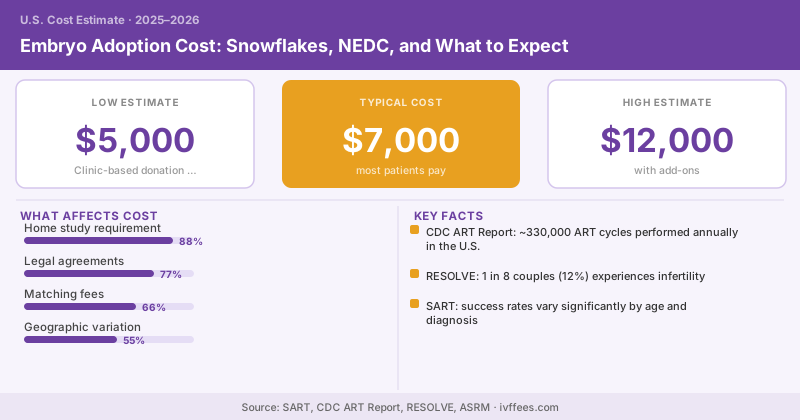
| Program Type | Low | Typical | High |
|---|---|---|---|
| Clinic-based donation (no agency) | $5,000 | $7,000 | $12,000 |
| NEDC (National Embryo Donation Center) | $8,000 | $12,000 | $18,000 |
| Snowflakes Embryo Adoption (Nightlight) | $10,000 | $15,000 | $25,000 |
| Independent matching (with attorneys) | $8,000 | $15,000 | $30,000 |
| Home study (if required) | $1,500 | $2,500 | $5,000 |
The Major Programs
Nightlight Christian Adoptions — Snowflakes Program
Snowflakes is the oldest and most well-known embryo adoption program in the U.S., founded in 1997. It operates using an adoption-style model: both the donating and receiving families go through a matching process, and a home study is required for recipients.
Costs through Snowflakes typically run $12,000–$20,000 for the adoption process, not including the medical transfer procedure itself (which adds another $3,000–$5,000). The matching model means you may know details about the donating family.
National Embryo Donation Center (NEDC)
Based in Knoxville, Tennessee, the NEDC is one of the largest embryo donation centers in the country. According to their published data, they’ve facilitated over 1,500 births since their founding in 2003. Their program is faith-based but open to recipients of different backgrounds.
NEDC costs range from $8,000–$15,000, which includes matching, legal coordination, and access to their embryo bank. The medical transfer costs are additional and paid directly to your clinic.
Clinic-Based Embryo Donation
Many fertility clinics maintain their own embryo donor banks, sourced from patients who’ve completed treatment and chosen to donate. This is typically the most affordable option — sometimes as low as $5,000–$8,000 — because there’s no agency intermediary.
The tradeoff: you usually have less information about the donor family, and matching is handled by the clinic’s medical team rather than through a personal matching process.
Agency programs (Snowflakes, NEDC) typically offer: more donor family information, personal matching, legal framework, support services, and sometimes open arrangements with contact. Clinic-based programs are simpler, faster, and cheaper — but with less information and no ongoing relationship with the donor family.
What Drives the Cost Difference?
The biggest cost drivers in embryo adoption are:
Home study requirement. Adoption-model programs require a home study conducted by a licensed social worker — the same process used in traditional child adoption. This adds $1,500–$5,000 and several months.
Legal agreements. Embryo donation involves contracts that define parental rights. Attorney fees for drafting and reviewing these agreements run $1,000–$3,000 per party.
Matching fees. Agency programs charge for staff time spent matching donors and recipients — reviewing profiles, facilitating introductions, coordinating preferences.
Geographic variation. Transfer costs depend on your local clinic, which may be nowhere near the embryo program’s location. Shipping frozen embryos between facilities adds $300–$800.
Medical Costs on Top of Program Fees
The program fee doesn’t include the actual frozen embryo transfer. You’ll pay your clinic separately for:
- Monitoring appointments (4–6 ultrasounds and blood draws)
- Medications to prepare your uterus (estrogen and progesterone)
- The transfer procedure itself
- Lab fees
A standard FET at a U.S. fertility clinic runs $3,000–$5,500 including medications. This is true whether you’re transferring your own embryos or donated ones.
Success Rates
According to SART data, frozen embryo transfer success rates using donated embryos are generally comparable to using own frozen embryos from a similar-aged donor. For donor embryos where the original egg was from a woman under 35, live birth rates per transfer often exceed 50%. This makes it one of the more cost-effective paths when factoring in the cost per live birth.
Embryo adoption is not legally standardized across states. In some states, the donation is treated as a medical procedure with minimal legal requirements. In others, courts have applied traditional adoption law. Work with an attorney who specializes in reproductive law in your state before finalizing any agreement.
Is Insurance Involved?
The medical transfer portion may be covered if your state has IVF insurance mandates that include FET procedures. The program/agency fees are almost never covered by insurance.
HSA and FSA funds can typically be used for the medical portions — the transfer, medications, and monitoring. Agency fees may not qualify, so check with your HSA administrator before assuming coverage.
The Bottom Line
Embryo adoption is genuinely one of the most affordable paths to parenthood for couples who can’t or don’t want to use their own eggs or sperm. If you’re comfortable with the legal and emotional aspects of the process, starting with a clinic-based program keeps costs lowest. If matching and open arrangements matter to you, programs like Snowflakes or NEDC offer that — at a higher price. Either way, it’s worth adding to your list of options.