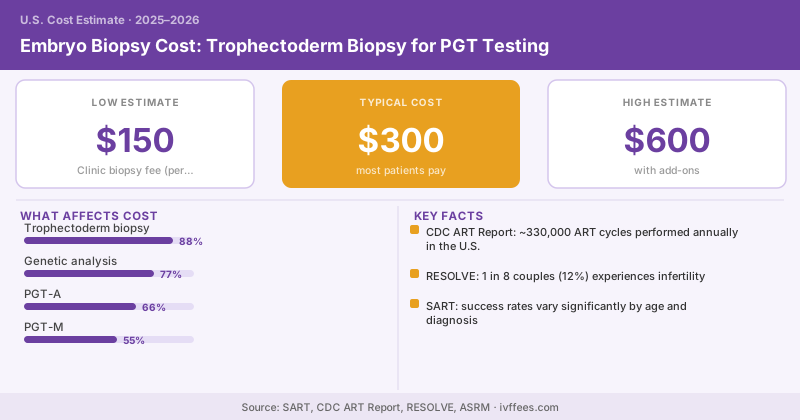
Most patients hear “PGT-A” and think of it as one thing — one cost, one step. It’s actually two distinct procedures: the embryo biopsy (performed by an embryologist at your fertility clinic) and the genetic analysis (performed by an external lab like CooperSurgical Genomics, Igenomix, or NovaStar). Both are billed separately, and together they add $1,500 to $5,000 to your IVF cycle.
The Biopsy vs. The Analysis: Understanding the Cost Split
Trophectoderm biopsy is the clinical procedure. An embryologist uses a laser or mechanical tool to remove 5–8 cells from the outer layer (trophectoderm) of a blastocyst — the cells that will become the placenta, not the embryo itself. The inner cell mass, which becomes the fetus, is not sampled.
The biopsy is performed at your fertility clinic, usually on day 5 or 6 of embryo development. After biopsy, embryos are vitrified and stored while the cell samples are shipped to the genetic testing lab.
Genetic analysis is performed off-site by a specialized genetics laboratory. For PGT-A (aneuploidy testing), they assess whether the embryo has the correct number of chromosomes. For PGT-M (monogenic disease testing), they look for specific inherited conditions.
| Embryo Biopsy & PGT Cost | Low | Typical | High |
|---|---|---|---|
| Clinic biopsy fee (per embryo) | $150 | $300 | $600 |
| Genetic lab fee (first embryo) | $1,200 | $1,800 | $3,000 |
| Per-additional-embryo lab fee | $100 | $200 | $400 |
| Total for 3–5 embryos biopsied | $1,500 | $2,500 | $5,000 |
How Pricing Is Usually Structured
Most genetics labs charge a case setup fee plus a per-embryo fee. You pay the setup fee regardless of how many embryos are tested — which is why PGT-A is more economically efficient when you have multiple embryos to test.
For example: a lab might charge $1,500 for setup plus $150 per embryo. If you’re testing 5 embryos, that’s $2,250 total. If you’re testing 1 embryo, that’s $1,650 — disproportionately expensive for a single embryo.
This pricing structure is one reason some REs recommend banking multiple retrieval cycles before testing — particularly for patients with diminished ovarian reserve who may only produce 1–2 blastocysts per cycle.
If you’re testing more than 5 embryos, ask the genetics lab about volume pricing. Many labs offer tiered pricing above certain thresholds. Your clinic’s financial coordinator often knows what discounts are available — ask them to facilitate.
PGT-A vs. PGT-M: Different Tests, Different Costs
PGT-A (aneuploidy testing) assesses chromosomal number. It’s used for patients concerned about age-related chromosomal abnormalities, recurrent miscarriage, or multiple failed transfers. The genetic lab fee is typically $1,500 to $2,500 depending on embryo count.
PGT-M (monogenic testing) detects specific inherited single-gene disorders — cystic fibrosis, Huntington’s disease, BRCA mutations, and hundreds of others. It requires custom probe design specific to your family’s mutation, which adds a one-time design fee of $1,000 to $2,500 on top of the per-embryo analysis costs.
PGT-SR (structural rearrangements) is used when one parent carries a chromosomal translocation. Pricing is similar to PGT-M with additional setup complexity.
What Does a Trophectoderm Biopsy Look Like?
The biopsy is performed under a high-powered microscope. An embryologist uses a laser to create an opening in the zona pellucida, then uses a specialized glass tool (biopsy pipette) to remove 5–8 trophectoderm cells. The whole process takes 2–5 minutes per embryo.
According to SART data, modern trophectoderm biopsy techniques have a very low risk of embryo damage when performed by experienced embryologists — with less than 1% of biopsied embryos damaged in the process. Older day-3 biopsy techniques had higher damage rates.
The Frozen Embryo Transfer Connection
After biopsy, embryos are vitrified and stored while results come back (typically 7–14 days). You’ll then proceed to a frozen embryo transfer — not a fresh transfer. This adds the cost of an FET cycle to your total, which typically runs $3,000 to $6,000.
Factor this into your total PGT cycle budget: biopsy + genetic analysis + embryo storage + FET.
PGT-A identifies chromosomally abnormal embryos as untransferable — but it doesn’t guarantee that a “normal” (euploid) embryo will implant and result in a live birth. ASRM data suggests euploid embryo success rates of 50–70% per transfer depending on age and other factors. PGT-A improves efficiency, but it’s not a guarantee.
Does Insurance Cover Embryo Biopsy?
Insurance coverage for PGT varies significantly. The biopsy procedure itself may be covered if IVF is covered; the genetic analysis from an external lab typically requires separate prior authorization and is often classified as genetic testing (a different benefit category than the IVF benefit).
Check both your IVF benefit and your genetic testing benefit before assuming PGT is covered under your plan.
Bottom Line
Embryo biopsy for PGT costs $1,500 to $5,000 for the full test-and-result process, depending on how many embryos are tested and which type of genetic analysis is needed. It adds meaningful value for specific patient populations — but like all IVF add-ons, the clinical indication should drive the decision, not routine inclusion.