In 2010, ERA testing barely existed. Today it costs $800 and some REs swear by it — while others say the evidence doesn’t justify the price. Here’s what you actually need to know before paying for one.
The ERA (Endometrial Receptivity Array) test identifies your personal “window of implantation” — the specific hours during your cycle when your uterine lining is most receptive to an embryo. The concept is compelling. But the data on whether it improves IVF outcomes for most patients is genuinely mixed. This guide breaks down the costs, what the test does, and who actually benefits.
ERA Test Cost Breakdown
| Item | Low | Typical | High |
|---|---|---|---|
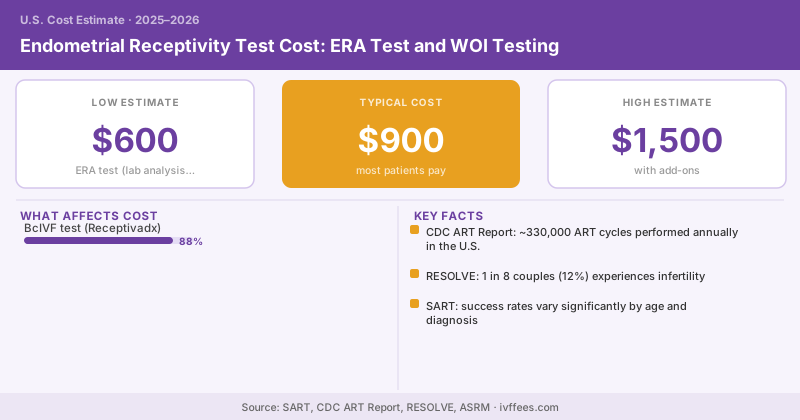
| ERA test (lab analysis only) | $600 | $900 | $1,500 |
| Biopsy procedure (clinic charge) | $200 | $400 | $800 |
| Mock cycle medications | $200 | $400 | $800 |
| Total ERA cycle cost | $800 | $1,600 | $3,000 |
| WOI repeat test (if needed) | $600 | $900 | $1,500 |
The ERA test itself is a lab service provided by Igenomix, the Spanish company that developed and patents the technology. The $600–$1,500 goes to them; your clinic bills separately for the biopsy procedure and the mock cycle drugs used to prepare your uterus to the right stage before sampling.
What the ERA Test Measures
Your endometrial lining goes through distinct phases during each menstrual cycle. The “window of implantation” (WOI) — typically days 19–21 of a standard cycle — is when implantation is most likely to succeed. But some women have displaced WOIs — earlier or later than average.
ERA testing takes a small biopsy of the uterine lining during a mock FET cycle, then analyzes the gene expression profile of that tissue. The results tell you whether your WOI is “receptive” or “non-receptive” at the standard timing, and if non-receptive, whether you need to transfer embryos earlier or later.
Based on results, your RE adjusts the progesterone start timing — sometimes by just 12–24 hours — to better match your personal window.
When Is ERA Testing Recommended?
Most reproductive endocrinologists recommend ERA testing for patients with:
- Recurrent implantation failure (RIF): Two or more failed FET cycles with chromosomally normal (euploid) embryos
- Unexplained failure: When embryo quality and uterine anatomy appear normal but transfers keep failing
- High-stakes single embryo transfers: Some REs use ERA proactively when a patient has limited euploid embryos
ERA is generally not recommended for first-time FET patients without a history of failure. The cost-benefit math doesn’t favor it when you don’t yet know you have a problem.
A landmark 2021 randomized controlled trial published in the New England Journal of Medicine (the STAR trial) found that ERA-guided transfers did NOT significantly improve live birth rates in women with recurrent implantation failure compared to standard timing. However, a subset of patients with genuinely displaced WOIs did show improvement. The test may help a specific subgroup — but predicting who that is before testing remains difficult.
Alternative Receptivity Tests
ERA is the original and most studied test, but competitors have entered the market:
EMMA (Endometrial Microbiome Metagenomic Analysis): Tests the bacterial environment of the uterine lining. An imbalance in the endometrial microbiome may affect implantation. Often offered alongside ERA by Igenomix.
ALICE (Analysis of Infectious Chronic Endometritis): Tests for chronic endometritis, a low-grade infection that can impair implantation. Sometimes offered as a bundle.
Some clinics offer ERA + EMMA + ALICE as a bundled package for $1,500–$2,500. Whether you need all three, or any of them, depends on your specific history.
BcIVF test (Receptivadx): A competing endometrial receptivity test based on different gene expression markers. Similar pricing to ERA.
The Mock Cycle: An Overlooked Cost
Here’s what many patients miss when budgeting for ERA: you need a full mock cycle to set up the test. This means estrogen for 12–14 days to build your lining, then progesterone to bring you to the specific stage being tested, then the biopsy.
That mock cycle uses real medications — the same estrogen patches and progesterone supplements you’d use in an actual FET. Medication costs for the mock cycle run $200–$600. And that cycle is spent on testing, not on an actual embryo transfer. So the opportunity cost is one additional month.
The ERA test requires a biopsy — a small tissue sample taken from inside your uterus. Most women describe it as a strong cramp or pressure, lasting 30–60 seconds. It’s done without anesthesia in most clinics. Some women find it very manageable; others find it more painful. Ask your clinic what to expect before scheduling.
Should You Pay for ERA?
Here’s the honest framework: if you’ve had two or more failed transfers with good embryos and no explanation, ERA is a reasonable next step. The test cost ($1,500–$2,500 all-in) is low compared to another failed FET cycle at $3,000–$5,000.
If you’re about to do your first FET and have no history of failure, ERA adds cost without proven benefit. Start with the standard timing and consider ERA only if that fails.
Insurance Coverage
ERA testing is rarely covered by insurance. It’s typically classified as investigational or experimental under most plans. However, the medications used in the mock cycle may be partially covered if your plan includes fertility drug benefits.
Some HSA/FSA accounts cover ERA as a qualified medical expense — check with your plan administrator, as this varies.
The Bottom Line
ERA testing costs $1,500–$3,000 all-in for the complete mock cycle. It’s most valuable for patients with unexplained recurrent implantation failure — and less supported by evidence for first-time transfers. If your RE recommends it, ask specifically why you personally are a candidate. The answer tells you a lot about whether the cost is justified in your case.