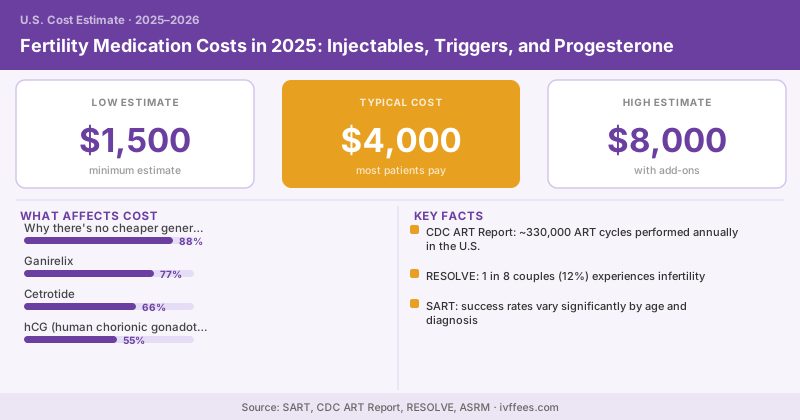
Nobody warns you that the clinic’s $12,000 IVF quote comes with a $4,500 pharmacy bill attached.
Fertility medications are often the biggest surprise in the IVF budget — and one of the few places where smart shopping genuinely reduces the cost. Here’s a complete guide to what you’ll take, what it costs, and how to lower that number.
The Big Picture: Medication Cost by Protocol
Your medication costs depend on your protocol and how your body responds. Women who respond strongly to stimulation need fewer drugs; poor responders may need significantly more, at higher cost.
| Medication Category | Typical Cost Range | What It Does |
|---|---|---|
| Gonadotropins (FSH/LH) | $1,800–$5,500 | Stimulate multiple egg development |
| GnRH agonist/antagonist | $300–$900 | Prevent premature ovulation |
| Trigger shot (hCG or Lupron) | $75–$400 | Final egg maturation |
| Progesterone supplementation | $100–$600/month | Support uterine lining post-transfer |
| Estrogen (FET cycles) | $50–$250 | Build uterine lining for frozen transfer |
| Total stimulation cycle | $2,500–$7,000 | |
| FET cycle medications | $150–$900 |
Gonadotropins: The Most Expensive Part
Injectable gonadotropins — the medications that stimulate your ovaries to develop multiple follicles — account for 70–80% of your medication budget.
Brand-name options and typical retail prices:
- Gonal-F (follitropin alfa, Merck): $300–$500 per 450IU pen. Most protocols use 2–4 pens per cycle.
- Follistim AQ (follitropin beta, Organon): Similar pricing to Gonal-F, $280–$480 per 900IU cartridge.
- Menopur (menotropins, Ferring): $90–$130 per 75IU vial. Protocols using Menopur require multiple vials daily — costs add up quickly.
- Rekovelle (follitropin delta, Ferring): Newer, FDA-approved biosimilar-class drug dosed by AMH level. May cost $200–$350 less per cycle than Gonal-F.
Why there’s no cheaper generic: Unlike most medications, gonadotropins are biologics — large protein molecules that can’t be replicated with standard generic manufacturing. The FDA’s biosimilar pathway for these drugs is still developing, so true price competition has been slow.
Compare prices between specialty pharmacies before filling. MDR Pharmacy, FertilityRx, Koala Meds, and Freedom Fertility regularly offer 20–40% discounts compared to retail pharmacies. Some specialty pharmacies also offer price-matching. Always call your clinic’s pharmacy partner last — they may not be the cheapest option.
GnRH Antagonists: Preventing Premature Ovulation
During stimulation, you’ll take a drug to prevent your ovaries from releasing eggs too early.
Ganirelix (ganirelix acetate, Organon): Approximately $80–$120 per prefilled syringe. Most protocols require 4–7 days.
Cetrotide (cetrorelix, EMD Serono): Similar pricing, $90–$130 per 0.25mg kit.
Generic versions of both are available and FDA-approved, typically at 30–50% lower cost than brand-name versions. Ask your clinic if they’re comfortable prescribing generics — most are.
Some protocols use Lupron (leuprolide) as a GnRH agonist for downregulation before stimulation. Lupron is significantly cheaper than antagonists ($50–$150 for the full protocol) but requires starting 2–4 weeks earlier.
Trigger Shots
The trigger shot causes final egg maturation 36 hours before retrieval.
hCG (human chorionic gonadotropin): Brand names Novarel and Pregnyl cost $75–$150. Generic hCG is available for $50–$100.
Ovidrel (recombinant hCG, prefilled syringe): More convenient, costs $90–$160.
Lupron trigger: Some clinics use a GnRH agonist (Lupron) as the trigger instead of hCG, particularly for patients at risk of ovarian hyperstimulation syndrome (OHSS). Lupron trigger typically costs $40–$80 for the injection, but it’s only an option if you’re on an antagonist protocol.
Progesterone: The Long Tail Cost
After embryo transfer, you’ll take progesterone to support early pregnancy. This continues until your first ultrasound confirms a heartbeat — at 8–10 weeks of pregnancy, typically.
Progesterone in oil (PIO): An intramuscular injection given daily. Inexpensive — $40–$80 per month depending on pharmacy and concentration. The primary downside is the daily deep intramuscular injection, which many patients find uncomfortable.
Vaginal progesterone: More comfortable to take, but significantly more expensive.
- Endometrin (inserts): $300–$500/month
- Crinone gel (8%): $350–$550/month
- Prometrium (oral taken vaginally): $150–$300/month
If you get pregnant, you’re potentially paying for 8–10 weeks of progesterone. Budget accordingly.
Manufacturer Assistance Programs
Both Merck (Gonal-F) and EMD Serono (Cetrotide, Saizen) run patient assistance programs for income-qualified individuals. Requirements and benefit amounts change, so check directly with manufacturers:
- Merck Fertility Program: merckfertility.com
- EMD Serono Compassionate Care: emdserono.com
- Ferring (Menopur): ferringusa.com
Some programs provide medications free of charge for qualifying patients. These programs are underutilized — many eligible patients don’t apply.
Never use expired or unverified medications, and don’t buy from unregulated online sources. Injectable fertility medications require proper temperature control (most need refrigeration) and sterile handling. Compromised medications can fail silently or cause complications.
Medication Sharing
Some IVF clinics facilitate medication donation programs — patients who have leftover, unused, unopened medications can donate them to other patients at the same clinic. This is legal in most states if the medications remain in original packaging and are transferred under medical supervision.
Ask your clinic if they have a medication-sharing program. Being on the receiving end can save hundreds to thousands of dollars on a cycle.
What to Expect Total
For a typical stimulation cycle, plan on $2,500–$5,000 in medications if you shop at specialty pharmacies. At retail pharmacy prices, the same protocol runs $3,500–$7,000. The difference is real money — often $1,000–$2,000 saved just by comparing prices before your first prescription is filled.
Pricing based on specialty pharmacy surveys conducted 2024–2025 and manufacturer published AWP (average wholesale prices). Actual costs vary by protocol, response, and insurance coverage.