Picture this: you and your partner have been trying for two years, your OB-GYN finally says the word “IVF,” and your first question is the obvious one — what’s this going to cost? In Houston, the answer starts at about $11,000 for the base procedure and climbs toward $16,000, with medications and extras stacked on top. The Bayou City is one of the more affordable major metros for fertility care, but the insurance picture has a catch worth understanding before you commit.
What IVF Actually Costs in Houston
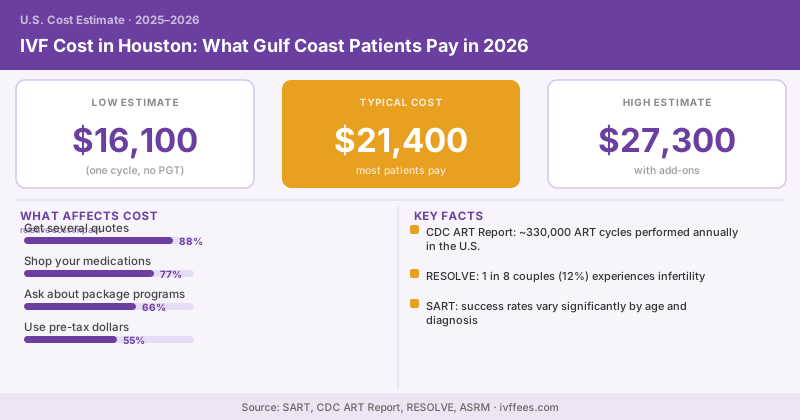
Base IVF procedure fees across the Houston metro run $11,000 to $16,000. Add medications, monitoring, and optional genetic testing, and an uninsured first cycle generally totals $15,500 to $23,500.
| Cost Component | Low End | Typical | High End |
|---|---|---|---|
| Base IVF procedure (Houston) | $11,000 | $13,500 | $16,000 |
| Fertility medications | $3,500 | $5,000 | $7,000 |
| Monitoring & labs | $1,000 | $1,500 | $2,500 |
| Anesthesia | $600 | $900 | $1,300 |
| PGT-A genetic testing (optional) | $3,500 | $5,000 | $7,500 |
| Frozen embryo transfer (if needed) | $3,000 | $4,500 | $6,500 |
| Total (one cycle, no PGT) | $16,100 | $21,400 | $27,300 |
Houston’s relatively low cost of living for a major metro keeps clinic overhead modest. Wages, lab space, and rent run cheaper than on the coasts, and that holds the base procedure fee down — even as the more or less fixed national cost of medications stays the same.
Texas’s IVF Mandate Has Big Loopholes
Texas does have an infertility insurance law, but Houston patients shouldn’t read too much into it. The mandate only requires certain insurers to offer IVF coverage; it doesn’t require them to include it, and self-funded employer plans — which cover a large share of working Texans — are exempt entirely. The upshot is that most Houston patients pay out of pocket despite the statute.
In practice, Texas behaves much more like Arizona or Georgia than like New York or New Jersey, where coverage is genuinely mandated. If you want to see exactly where each state lands, the IVF insurance mandate by state breakdown spells it out.
Houston’s energy and healthcare sectors help here. Major employers in oil and gas, the Texas Medical Center, and large national firms with Houston operations have increasingly added voluntary fertility benefits — part of the corporate trend RESOLVE has documented nationwide. That voluntary benefit, not the state mandate, is what most covered Houston patients are actually relying on.
Texas’s IVF mandate only requires insurers to offer coverage, and self-funded plans are exempt — so most Houston patients pay out of pocket. Your realistic path to coverage is a voluntary employer benefit, increasingly common among Houston’s energy and Medical Center employers. Check with HR before assuming you’re uncovered.
Houston’s Clinic Market
Houston is anchored by the Texas Medical Center, the largest medical complex in the world, which gives the metro unusual depth in reproductive medicine and adjacent specialties. Beyond the Medical Center, clinics span the metro from the Galleria area to the suburbs, with a mix of independent practices and national network locations.
That clinical depth makes Houston a regional draw for the Gulf Coast, pulling patients from across southeast Texas and Louisiana. According to CDC ART surveillance data, Texas clinics perform a high annual volume of cycles, with Houston as one of the two main centers alongside Dallas-Fort Worth. The competition and volume help keep pricing reasonable and give you room to compare.
How to Keep Houston IVF Costs Down
Get several quotes. DFW-level competition exists here too — Houston clinic prices vary by thousands of dollars. Compare itemized estimates.
Shop your medications. At $3,500–$7,000, drugs are a major cost. National specialty pharmacies frequently undercut local retail, so comparing fertility medication costs is a quick win.
Ask about package programs. Several Houston clinics offer multi-cycle or refund-guarantee packages that lower per-cycle exposure.
Use pre-tax dollars. Texas has no state income tax, so the HSA/FSA benefit is federal-only — still worth maxing an HSA before your cycle.
If you still face a gap, Houston clinics widely offer IVF financing options through partnered lenders.
According to SART national data, the live birth rate per egg retrieval for women under 35 is roughly 49% and drops with age. One cycle is not a guarantee. Ask your Houston clinic for age- and diagnosis-specific success rates, and plan financially for the chance of a second round.
Frequently Asked Questions
Does insurance cover IVF in Houston? Often not. Texas’s mandate only requires insurers to offer IVF, and self-funded plans are exempt, so most Houston patients pay out of pocket. Confirm your IVF coverage for 2025 with your insurer and HR.
Is Houston a good place for IVF? Yes. Anchored by the Texas Medical Center, Houston has deep clinical resources and a competitive market, making it a regional hub for the Gulf Coast.
How can I lower my Houston IVF costs? Compare clinics across the metro, shop medications, ask about package programs, and use HSA dollars. See how to reduce IVF cost.
Cost data based on Houston-area clinic fee schedules, CDC ART surveillance data, SART national data, RESOLVE analysis, and Texas insurance mandate status. Individual costs vary by clinic, protocol, and employer coverage.