The DMV is one of the few metros in America where the state line running through your commute can decide whether your IVF is covered. Live in DC, work in Maryland, treat at a Virginia clinic — and three different sets of insurance rules might be in play. Add some of the richest federal-employee benefits in the country, and Washington becomes one of the more coverage-friendly fertility markets out there. But you have to know how to read it.
What IVF Actually Costs in Washington DC
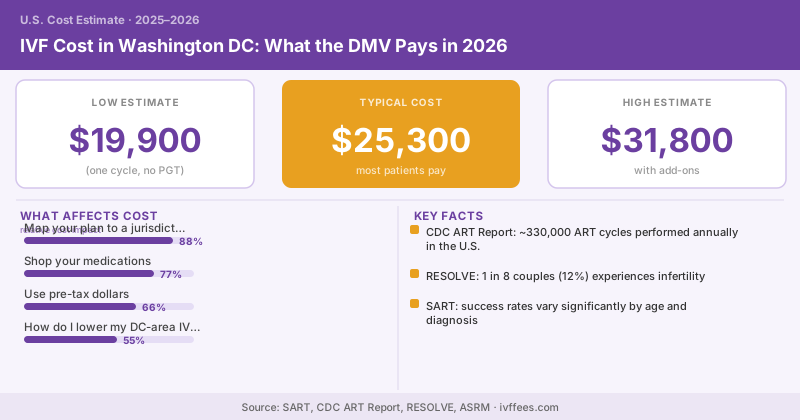
Base IVF procedure fees across the DC metro — including Northern Virginia and suburban Maryland — run $14,000 to $20,000. Add medications, monitoring, and optional genetic testing, and an uninsured first cycle typically totals $19,000 to $28,000.
| Cost Component | Low End | Typical | High End |
|---|---|---|---|
| Base IVF procedure (DC metro) | $14,000 | $17,000 | $20,000 |
| Fertility medications | $4,000 | $5,500 | $7,500 |
| Monitoring & labs | $1,200 | $1,800 | $2,800 |
| Anesthesia | $700 | $1,000 | $1,500 |
| PGT-A genetic testing (optional) | $4,000 | $5,500 | $8,000 |
| Frozen embryo transfer (if needed) | $3,500 | $5,000 | $7,000 |
| Total (one cycle, no PGT) | $19,900 | $25,300 | $31,800 |
The DC metro is one of the highest cost-of-living areas in the country, with housing and wages well above the national average. That overhead flows into clinic pricing, pushing base fees toward the upper-middle of the national range.
DC, Maryland, and Virginia All Have Different IVF Rules
This is the defining feature of the DMV. The three jurisdictions don’t treat IVF the same way:
- Maryland has a longstanding infertility insurance mandate that includes IVF coverage for certain plans, subject to eligibility conditions.
- DC has its own fertility coverage requirements that have expanded in recent years.
- Virginia has more limited requirements and generally does not mandate comprehensive IVF coverage the way Maryland does.
Which rule applies to you depends on where your insurance plan is regulated — not necessarily where you live or where the clinic sits. A Northern Virginia resident on a Maryland-based plan could have mandated coverage; a DC resident on a self-funded federal contractor plan might not. For the broader national picture, the IVF insurance mandate by state overview is a useful companion.
On top of all that, the DC area’s enormous federal workforce has access to FEHB plans, several of which include meaningful fertility benefits, and large government contractors increasingly add voluntary fertility coverage — consistent with the employer trend RESOLVE has documented.
In the DMV, your IVF coverage depends on which jurisdiction regulates your plan, not where you live. Maryland mandates IVF for some plans, DC has its own requirements, and Virginia is more limited. Plus, many federal employees have FEHB fertility benefits. Pin down your plan’s home jurisdiction before assuming anything.
The DC Metro’s Clinic Market
The DMV supports a deep, sophisticated fertility market spread across the District, Northern Virginia, and the Maryland suburbs. With a highly educated, high-income population and major academic medical centers in the region, the metro has plenty of established clinics and reproductive specialists.
That density gives patients real choice — and the ability to treat across state lines if it helps with coverage or convenience. A patient might do monitoring near home in Virginia and retrieval at a Maryland clinic, or vice versa, depending on logistics and which clinic best fits their plan and diagnosis.
How to Keep DC IVF Costs Down
Map your plan to a jurisdiction. This is the single most valuable step in the DMV. Maryland-regulated and certain DC plans may carry mandated IVF coverage worth tens of thousands.
Federal employees, check your FEHB options. Some FEHB plans offer better fertility benefits than others, and open season is your chance to switch. This can be a major lever.
Shop your medications. At $4,000–$7,500, drugs are a big cost. National specialty pharmacies often beat local retail — compare fertility medication costs.
Use pre-tax dollars. Maryland, Virginia, and DC all have income taxes, so HSA and FSA contributions deliver combined federal and local savings. Fund an HSA before your cycle.
If a gap remains, DMV clinics widely offer IVF financing options.
Per SART national data, the live birth rate per egg retrieval for women under 35 is around 49% and declines with age. A single cycle is not a guarantee. Ask your DC-area clinic for age- and diagnosis-specific success rates and budget for the possibility of a second round.
Frequently Asked Questions
Does Washington DC require insurance to cover IVF? DC has its own fertility coverage requirements that have expanded recently, and Maryland mandates IVF for certain plans, while Virginia is more limited. Coverage depends on which jurisdiction regulates your specific plan. Confirm your IVF coverage for 2025.
Do federal employees in DC get IVF coverage? Some FEHB plans include fertility benefits, though they vary widely. Federal workers should compare plan options during open season, as the difference in fertility coverage can be substantial.
How do I lower my DC-area IVF bill? Identify which jurisdiction regulates your plan, compare FEHB options if you’re federal, shop medications, and use HSA dollars. See how to reduce IVF cost.
Cost data based on DC-metro clinic fee schedules, SART national data, RESOLVE analysis, and DC, Maryland, and Virginia insurance mandate status. Individual costs vary by clinic, protocol, and employer or federal coverage.