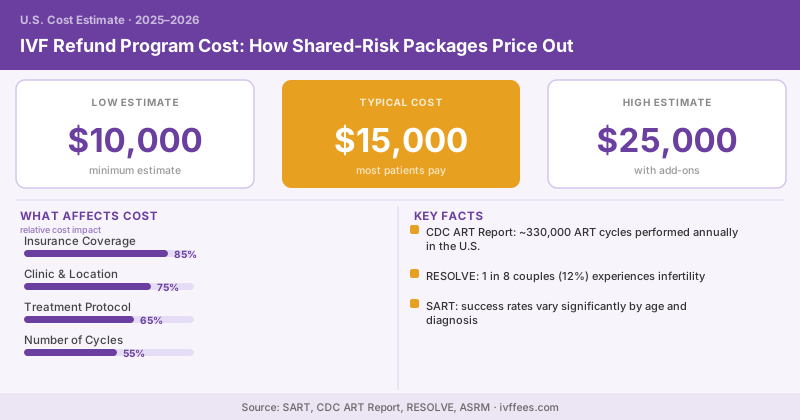
Pay $8,000 more upfront, or risk paying $22,000 for nothing — that’s the trade-off at the heart of every IVF refund program, sometimes called a shared-risk or multi-cycle guarantee package.
What a Typical Refund Program Costs
| Program Type | Cycles Included | Upfront Cost | Refund If Unsuccessful |
|---|---|---|---|
| 2-cycle refund package | 2 | $18,000 – $20,000 | 70%–80% |
| 3-cycle refund package | 3 | $24,000 – $28,000 | 80%–90% |
| 6-cycle refund package (multi-clinic networks) | 6 | $28,000 – $35,000 | 70%–100% |
| Standard per-cycle payment (no refund) | 1 | $14,000 – $22,000 | N/A |
Compare the per-cycle package cost against simply paying for individual cycles as you go — the refund program almost always costs more per included attempt, and that premium is essentially the price of the guarantee itself.
Why Clinics Can Offer a Refund at All
Refund programs work because clinics have statistical data — often built on their own SART-reported outcomes — showing that a defined group of eligible patients (typically younger, with reasonable ovarian reserve and no major complicating diagnoses) has a predictable cumulative success rate across multiple cycles. The program is priced so that, across their full pool of enrolled patients, the clinic comes out roughly financially even or ahead, even while individual patients who don’t succeed get most of their money back.
Ask your RE for your personalized, age- and diagnosis-adjusted cumulative live birth rate across the number of cycles included in a refund package — not the clinic’s general marketing statistic. If your individual odds of success within the included cycles are high, paying per cycle is very likely the cheaper option; refund programs are priced to protect the clinic against exactly the patients whose odds are more uncertain.
Eligibility Requirements Are Stricter Than You’d Expect
Because the clinic is taking on real financial risk, refund programs typically have firmer eligibility cutoffs than standard IVF treatment — often excluding patients over a certain age (commonly 40-42), those with very low AMH or a history of poor response to stimulation, or certain diagnoses associated with lower success rates. If you don’t qualify for a refund program at one clinic, it’s not necessarily a reflection of your odds broadly — ask about eligibility criteria specifically and whether a different program tier might fit.
What Counts as a “Refund Trigger” Varies
Refund programs differ in exactly what triggers a refund and how much you get back — some pay out only if you don’t achieve a clinical pregnancy at all, others tie the refund specifically to a confirmed live birth, and the percentage refunded (70% to 100%) varies by program and by clinic. Read the contract terms extremely carefully, including how transfers, frozen embryos, and any embryos remaining in storage at the end of the program are handled if you don’t use all included attempts.
Don’t enroll in a multi-cycle refund program without reading the full contract for what happens if you want to stop partway through — whether for medical reasons, a change in family planning, or simply exhaustion with the process. Some programs have limited or no partial refund if you discontinue before using all included cycles, which is a meaningfully different risk than the “unsuccessful outcome” refund the marketing usually emphasizes.
When a Refund Program Makes the Most Sense
Refund programs tend to make the most financial and emotional sense for patients who are statistically likely to need more than one cycle — commonly patients in their late 30s, those with diminished ovarian reserve, or those with a history of one or more prior failed cycles — where the peace of mind of a capped financial risk offsets the higher per-cycle price. For patients with strong individual odds, the math usually favors paying per cycle.
The Bottom Line
Budget $18,000–$35,000 upfront for a typical IVF refund program, understanding you’re paying a real premium for a capped financial risk, not a discount. Get your personalized odds from your RE, read the refund trigger and discontinuation terms carefully, and compare the total cost against paying per cycle before assuming the refund program is automatically the better deal.