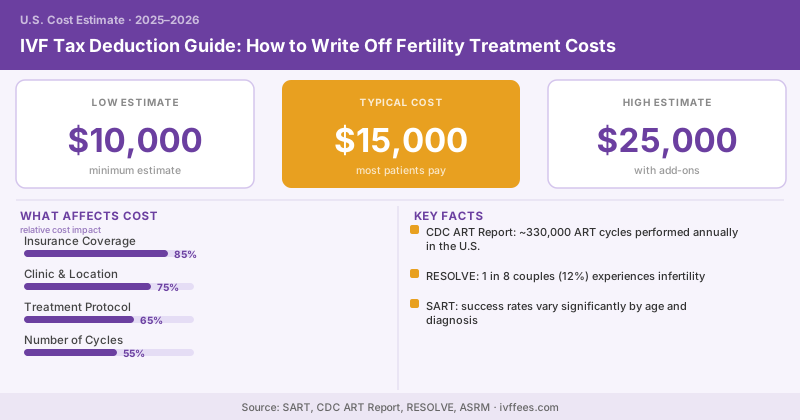
The IRS will let you deduct thousands of dollars in fertility treatment costs — but only the portion above a threshold most patients have never heard of, and only if you do the paperwork right. Here’s exactly how the math works.
The 7.5% AGI Threshold, Explained
The IRS treats IVF as a qualified medical expense under Section 213(d), alongside costs like egg retrieval, embryo transfer, fertility medications, monitoring, donor egg or sperm fees, and even some travel costs for treatment. But you can only deduct the amount of your total medical expenses for the year that exceeds 7.5% of your adjusted gross income (AGI).
| Household AGI | 7.5% Threshold | Total Medical/IVF Costs | Deductible Amount |
|---|---|---|---|
| $75,000 | $5,625 | $18,000 | $12,375 |
| $100,000 | $7,500 | $20,000 | $12,500 |
| $150,000 | $11,250 | $22,000 | $10,750 |
| $200,000 | $15,000 | $25,000 | $10,000 |
Notice the pattern: higher income means a higher threshold, which shrinks your deductible amount even when your IVF spend is the same. This deduction disproportionately helps middle-income households with a single, expensive treatment year.
What Counts as a Deductible Fertility Expense
The IRS has ruled favorably on a fairly broad list of fertility-related costs, including:
- IVF procedure and lab fees
- Fertility medications (prescribed)
- Egg or sperm donor fees, in many cases
- Embryo storage and cryopreservation
- Travel expenses to and from treatment (mileage or actual cost, within limits)
- Fertility testing and diagnostic bloodwork
Surrogacy-related costs have a murkier IRS history — some rulings have disallowed surrogate compensation as a deduction for the intended parents, while allowing costs directly tied to the intended parent’s own medical procedures. If surrogacy is part of your journey, this is a place to get a CPA’s specific read rather than assume.
The medical expense deduction only helps if you itemize, and itemizing only makes sense if your total itemized deductions — medical expenses, mortgage interest, state and local taxes (capped at $10,000), and charitable donations — exceed the standard deduction ($14,600 single / $29,200 married filing jointly for the 2024 tax year, adjusted for inflation each year). Run both scenarios before assuming the deduction helps you.
A Worked Example
Say you’re married filing jointly with $120,000 in combined AGI, and you spent $22,000 on an IVF cycle plus $2,000 in other medical costs during the year, for $24,000 total medical spend. Your 7.5% threshold is $9,000, so you can deduct $15,000. If your other itemized deductions (mortgage interest, SALT) already total $16,000, adding the $15,000 medical deduction brings you to $31,000 total — above the $29,200 standard deduction, so itemizing wins. In the 22% bracket, that’s roughly $3,300 in tax savings from the medical deduction portion alone.
Don’t Double-Dip With HSA/FSA Funds
You cannot deduct expenses you already paid for using pre-tax HSA or FSA dollars — that would be a double tax benefit, and the IRS disallows it. Keep careful records of which costs were paid out-of-pocket versus with HSA/FSA funds, since only the out-of-pocket portion is eligible for the medical expense deduction. Our HSA and FSA guide breaks down how those accounts work alongside this deduction.
Keep every receipt, invoice, and EOB from your fertility treatment for at least three years — the IRS can and does request documentation for large medical deductions, and fertility costs are exactly the kind of big, unusual expense that can trigger a closer look. A shoebox of paper receipts won’t cut it if audited; keep digital copies organized by date and provider.
The Bottom Line
IVF costs are deductible, but only above 7.5% of your AGI and only if you itemize. Run the numbers with your specific income and total medical spend before assuming this saves you money — for many patients with a single expensive treatment year, it genuinely does, often to the tune of several thousand dollars. Talk to a CPA experienced with medical deductions before filing, especially if surrogacy or donor costs are part of your situation.