“Your AMH is 0.4.” For a lot of women, that sentence triggers a financial spiral — visions of endless cycles and donor eggs. But a low anti-Müllerian hormone level is not a measure of whether you can get pregnant; it’s a measure of how many eggs you have left to work with. Understanding that difference is the first step to spending your money wisely.
AMH reflects your remaining egg supply, and it’s one of the most useful predictors of how you’ll respond to IVF stimulation. ASRM notes that ovarian reserve tests like AMH predict response to stimulation better than they predict the chance of natural pregnancy. Here’s what treatment costs when AMH is low.
What Low AMH Means for Treatment
AMH doesn’t tell you about egg quality — only quantity. A 32-year-old with low AMH may have good-quality eggs but fewer of them, while a 42-year-old’s lower AMH compounds with age-related quality decline. That distinction drives both your odds and your costs.
The practical effect: low AMH usually predicts fewer eggs per egg retrieval, which means you may need more cycles to gather enough embryos. That’s the main cost driver.
| Treatment Path | Low | Typical | High |
|---|---|---|---|
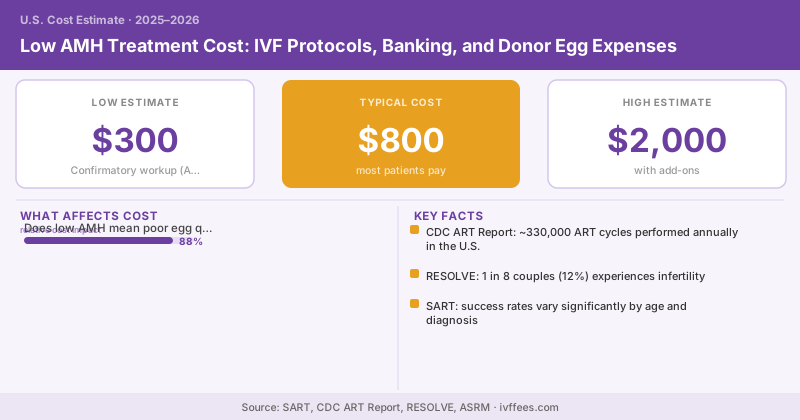
| Confirmatory workup (AMH, FSH, AFC) | $300 | $800 | $2,000 |
| Mild/mini-IVF cycle | $7,000 | $11,000 | $16,000 |
| Conventional IVF (high-dose protocol) | $14,000 | $20,000 | $30,000 |
| Embryo banking (2–3 retrievals) | $24,000 | $42,000 | $60,000 |
| PGT-A on banked embryos | $1,500 | $4,000 | $7,000 |
| Donor-egg IVF | $20,000 | $28,000 | $45,000 |
Protocol Strategy: Quantity vs. Cost
With low AMH, your RE picks a stimulation philosophy. Conventional high-dose protocols try to recruit every available follicle and cost more in fertility medications. Mild or mini-IVF accepts that you’ll get fewer eggs anyway and uses lower drug doses to cut cost per cycle.
Neither is automatically cheaper overall. Mini-IVF saves on drugs per cycle but may need more cycles to bank embryos. Conventional protocols cost more upfront but may collect more eggs in one go. The right call depends on your age, your AMH, and how your ovaries actually respond.
Low AMH is about egg quantity, not quality — and quality (driven mostly by age) is what determines whether an embryo becomes a baby. A young woman with low AMH often has a much better prognosis than her number suggests. Don’t make panic decisions or jump to donor eggs based on AMH alone; pair it with your age and antral follicle count before committing big money.
The Banking Strategy
Because each cycle may yield only a few eggs, many low-AMH patients use embryo banking — running multiple IVF retrievals back to back, freezing embryos each time, and accumulating a larger pool before testing and transferring. This maximizes the chance of having a euploid embryo to transfer, but it’s the most expensive path because you’re paying for several retrievals.
Banking 2–3 cycles can run $24,000 to $60,000 before transfer. The upside is efficiency for women with time pressure: you build your embryo bank quickly rather than spreading attempts over years.
Beware clinics or supplements promising to “raise” your AMH. AMH reflects your finite egg reserve, which can’t be meaningfully increased. DHEA and CoQ10 are sometimes used to support response, but evidence is mixed and they don’t grow your egg supply. Money spent chasing a higher number is usually money wasted — spend it on a sound treatment plan instead.
When Donor Eggs Make Sense
If repeated cycles yield few or no usable embryos — especially when low AMH combines with older age and poor egg quality — donor eggs become the highest-success route at $20,000 to $45,000. Because donor-egg success depends mainly on the donor’s age, it sidesteps the quantity-and-quality problem entirely. Many women set a limit on own-egg attempts before pivoting, balancing cost, odds, and emotion.
Insurance and Low AMH
The AMH test and reserve workup are usually inexpensive and often covered as routine bloodwork, even on plans that exclude fertility treatment. IVF and donor-egg coverage follow your state mandate, with donor fees typically out of pocket. Since low AMH often means multiple cycles or banking, reviewing IVF financing options early — and getting a full fertility testing workup — helps you plan realistically.
Frequently Asked Questions
Can I get pregnant naturally with low AMH? Yes. AMH predicts response to IVF stimulation, not your ability to conceive naturally. Many women with low AMH conceive on their own — it mainly signals you may have a shorter window and fewer eggs to work with over time.
Does low AMH mean poor egg quality? No. AMH measures egg quantity, not quality. Quality is driven mostly by age. A younger woman with low AMH typically has better-quality eggs (and a better prognosis) than her AMH number alone implies.
Should I freeze eggs immediately if my AMH is low? Possibly, if you’re not ready to conceive — a low reserve means the window is narrowing. But the decision should weigh your age, antral follicle count, and goals, since low AMH also means each freezing cycle may yield fewer eggs.
Bottom Line
Low AMH treatment ranges from an $11,000 mild IVF cycle to $60,000 for multi-cycle embryo banking, with donor eggs at $20,000–$45,000 as a high-success fallback. The crucial insight is that AMH measures quantity, not quality — your age matters far more for whether an embryo becomes a baby. Confirm the number, pair it with age and antral follicle count, and build a cost-aware plan with an RE rather than reacting to the AMH figure alone.