What if you could try IVF for under $10,000 instead of $20,000? That’s the pitch behind minimal stimulation IVF — often called mini-IVF — and for the right patient, it’s not just marketing. It’s a real, lower-cost path to pregnancy that trades egg quantity for a smaller bill.
What Minimal Stimulation IVF Costs
The cost advantage of mini-IVF comes almost entirely from the medication line item.
| Cost Component | Low End | Typical | High End |
|---|---|---|---|
| Base procedure fee (retrieval + lab) | $4,000 | $5,500 | $7,500 |
| Oral medications (clomiphene/letrozole) | $50 | $150 | $300 |
| Low-dose injectable gonadotropins (optional) | $200 | $600 | $1,200 |
| Monitoring & labs | $600 | $900 | $1,500 |
| Embryo transfer | $1,500 | $2,200 | $3,500 |
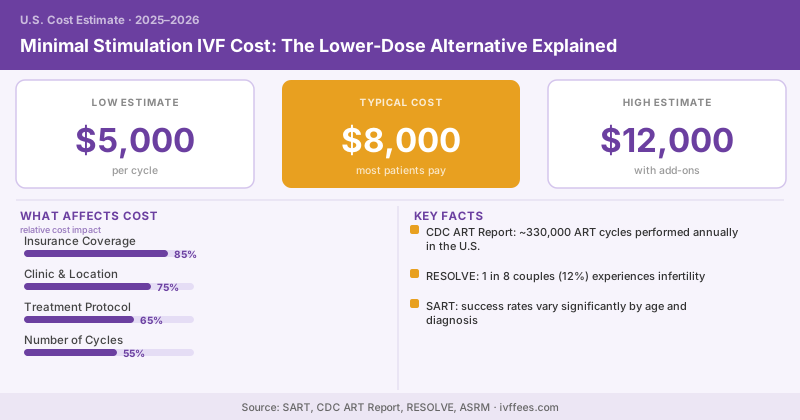
| Total per cycle | $5,000 | $8,000 | $12,000 |
Compare that to a conventional IVF cycle, where gonadotropins alone often run $3,000–$6,000. That single drug line item is why mini-IVF can cost a third to half of a standard cycle.
How Minimal Stimulation Actually Works
Instead of high-dose daily injections designed to recruit 10–20 follicles, mini-IVF uses oral fertility drugs — usually clomiphene citrate or letrozole — sometimes paired with a small dose of injectable gonadotropins. The goal isn’t to maximize egg count; it’s to retrieve a handful of good-quality eggs (typically 2–5) with far less medication, fewer monitoring visits, and a gentler experience overall.
According to fertility research summarized by ASRM, minimal stimulation protocols are frequently used for patients with diminished ovarian reserve, those who don’t respond well to high-dose stimulation anyway, or patients prioritizing lower cost and lower physical burden over maximum egg yield per cycle.
Who Mini-IVF Makes Sense For
Minimal stimulation isn’t the right call for everyone, but it fits several patient profiles well:
- Poor responders who don’t produce many eggs on high-dose protocols anyway — paying for maximum stimulation may not buy much benefit
- Patients prioritizing egg quality over quantity, since some research suggests lower-dose stimulation may reduce stress on developing follicles
- Budget-constrained patients who can’t afford a $20,000+ conventional cycle but can afford multiple $6,000–$9,000 mini-IVF attempts
- Patients wanting to avoid OHSS (ovarian hyperstimulation syndrome), a risk that rises with high-dose stimulation
Mini-IVF’s per-cycle egg yield is lower, so many clinics recommend budgeting for 2–3 cycles to bank enough embryos for a reasonable shot at pregnancy. Two mini-IVF cycles at $8,000 each ($16,000 total) may land close to the cost of one conventional cycle — but check your clinic’s specific numbers before assuming the math works in your favor.
The Trade-Off You’re Making
Fewer eggs per cycle means fewer embryos to work with, and fewer embryos means lower odds of a euploid (chromosomally normal) embryo surviving to transfer, especially for patients over 38. A 2022 Fertility and Sterility analysis found that cumulative live birth rates after multiple mini-IVF cycles can approach conventional IVF outcomes for some patients — but this depends heavily on age and starting ovarian reserve, and isn’t guaranteed for everyone.
Don’t choose mini-IVF purely on price without discussing your specific ovarian reserve and age with your RE. For younger patients with normal reserve, conventional stimulation may actually be the more cost-efficient path per live birth, since it produces more embryos in a single cycle. Mini-IVF’s savings are real, but only if it fits your biology.
Bottom Line
Minimal stimulation IVF costs $5,000–$12,000 per cycle, roughly a third to half of conventional IVF, with nearly all the savings coming from a smaller medication bill. It’s a legitimate option for poor responders and budget-conscious patients, but plan for multiple cycles and talk through the egg-count trade-off with your clinic before committing.