Two tests share three letters and a hyphen, yet one can cost three times more than the other. PGT-A and PGT-M get confused constantly, and that confusion can lead to a surprise on your invoice. Let’s clear it up.
Both are forms of preimplantation genetic testing performed on embryos created through IVF. But they answer completely different questions, and the price gap reflects that.
What Each Test Looks For
PGT-A (aneuploidy) screens embryos for the right number of chromosomes. Embryos with extra or missing chromosomes — aneuploidy — usually fail to implant or miscarry. PGT-A is used to pick chromosomally normal (euploid) embryos for transfer.
PGT-M (monogenic) tests for a specific single-gene disorder that runs in a family — think cystic fibrosis, Huntington’s disease, or sickle cell. It requires a custom genetic probe built around the exact mutation in your family, which is the main reason it costs more.
Both rely on an embryo biopsy, where a few cells are removed from each blastocyst for analysis.
How the Costs Compare
| Genetic Test Component | Low | Typical | High |
|---|---|---|---|
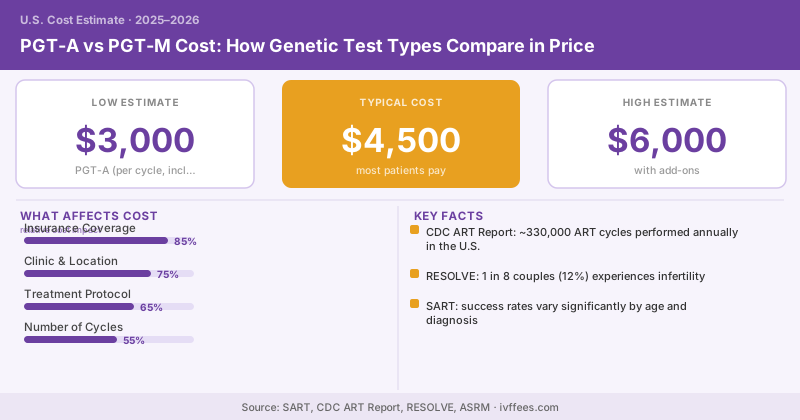
| PGT-A (per cycle, includes biopsy + analysis) | $3,000 | $4,500 | $6,000 |
| PGT-M probe development (one-time) | $2,000 | $3,000 | $5,000 |
| PGT-M per-cycle testing | $3,000 | $4,500 | $6,000 |
| PGT-M total (probe + first cycle) | $5,000 | $7,500 | $11,000 |
The big driver for PGT-M is the one-time probe design. It’s custom-built for your family’s mutation, and that lab work happens before any embryo is tested.
PGT-A screens for chromosome count and costs $3,000–$6,000 per cycle. PGT-M tests for a specific inherited disease and adds a one-time probe fee of $2,000–$5,000 on top of per-cycle testing, often pushing the total past $8,000.
Why the Probe Fee Exists
For PGT-A, the lab uses a standard chromosome-counting platform that works for everyone. No customization needed.
For PGT-M, the lab has to identify the precise location of your mutation, often by analyzing DNA from you, your partner, and sometimes relatives. Then it builds a test that can detect that exact variant in an embryo. That’s skilled, individualized work, and it’s billed as a separate setup cost.
What the Evidence Says About PGT-A
PGT-M is well-established for couples with a known single-gene disorder — the clinical case is clear. PGT-A is more debated.
A landmark 2021 multicenter trial (the STAR trial) found that PGT-A did not significantly improve overall live birth rates for the general IVF population, though it may help reduce miscarriage and time to pregnancy in certain groups, such as older patients. The ASRM has noted that PGT-A’s benefit varies by patient age and circumstance and shouldn’t be assumed universal. CDC ART data has long shown that aneuploidy rises sharply with maternal age, which is why PGT-A is more often discussed for patients over 35.
So PGT-A is a screening tool with situational value, while PGT-M is a targeted diagnostic for a defined genetic risk.
Choosing Between Them
You generally need PGT-M only if you and your partner are known carriers of a serious single-gene condition. PGT-A is the broader screening many clinics offer for embryo selection. Some patients do both in one cycle. Either way, these tests are a meaningful share of the full IVF cost, so ask your clinic to spell out the probe fee, the biopsy fee, and the per-embryo analysis separately. For the umbrella view, see our PGT genetic testing guide.
Frequently Asked Questions
Can I do PGT-A and PGT-M at the same time? Yes. Many couples with a known genetic disease run both on the same embryos — PGT-M to avoid passing on the disorder and PGT-A to check chromosome count. You’ll pay for both, but the biopsy is typically shared, so you’re not billed twice for cell removal.
Why is PGT-M so much more expensive than PGT-A? The one-time probe development fee. PGT-M requires a custom test built around your family’s exact mutation, which can add $2,000–$5,000 before any embryo is analyzed. PGT-A uses a standard platform with no customization.
Is PGT-A worth it if I’m under 35? The evidence is mixed. The 2021 STAR trial found PGT-A didn’t significantly improve overall live birth rates, and aneuploidy is less common in younger patients per CDC ART data. Talk to your doctor about whether it makes sense for your age and history.
PGT-M probe fees are sometimes quoted separately from cycle costs and can be missed in early estimates. Always ask whether the probe development fee is included in any “PGT” price you’re given.