Maria was 39 when her first IVF cycle produced two eggs. Her clinic’s next words weren’t about protocol tweaks — they were about a bigger pharmacy bill. That’s the reality poor responders run into: the label doesn’t just describe your ovaries, it changes your invoice.
If your antral follicle count is low, your AMH came back under 1.0, or a prior cycle yielded a handful of eggs or fewer, your reproductive endocrinologist has likely used the word “poor responder.” Here’s what that classification actually costs.
What a Poor Responder Protocol Costs
Poor responders usually need higher gonadotropin doses, sometimes combined with adjuvant medications like growth hormone or testosterone priming, to coax follicles into developing.
| Cost Component | Low End | Typical | High End |
|---|---|---|---|
| Base IVF procedure fee | $10,000 | $13,000 | $17,000 |
| High-dose gonadotropins | $4,500 | $6,500 | $9,000 |
| Adjuvant medications (DHEA, growth hormone) | $300 | $700 | $1,500 |
| Monitoring & labs (extra visits) | $1,200 | $1,800 | $2,800 |
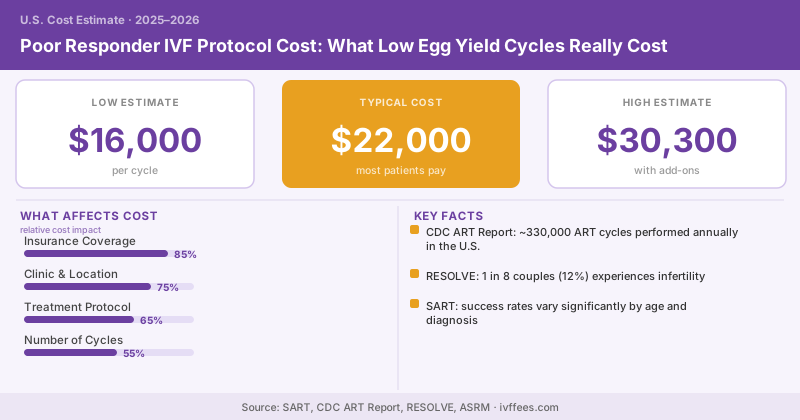
| Total per cycle | $16,000 | $22,000 | $30,300 |
The Bologna criteria, used widely by U.S. reproductive endocrinologists, define a poor responder as someone with two of three factors: advanced maternal age or a known risk factor, a prior poor ovarian response, or an abnormal ovarian reserve test. If you meet the definition, expect your medication line item to run well above the national average.
Why Poor Responders Pay More
The math is simple: more medication days and higher daily doses mean a bigger pharmacy invoice, and that invoice can equal or exceed the clinic’s procedure fee. A 2023 ASRM committee opinion noted that poor responders often require gonadotropin doses of 300–450 IU daily, compared to 150–225 IU for average responders — sometimes doubling the drug cost of the cycle.
There’s also a cancellation risk baked into the price. Poor responders are more likely to have a cycle cancelled after starting medications, because too few follicles develop to justify continuing to retrieval. When that happens, you’ve paid for drugs and monitoring with no retrieval to show for it — a sunk cost that doesn’t appear in any published fee schedule.
Before starting a poor responder protocol, ask your clinic directly: what percentage of poor responder cycles get cancelled before retrieval, and what happens to your bill if that happens? Some clinics discount or waive the procedure fee for a cancelled cycle but still charge for medications used. Get this in writing.
Protocol Options and What They Cost
Not every poor responder needs the same approach. Options your RE might discuss:
- High-dose antagonist protocol — the standard approach, described above, running $16,000–$30,000 all-in
- Minimal stimulation (mini-IVF) — lower doses, lower cost ($6,000–$10,000), but typically fewer eggs per cycle
- Natural cycle IVF — minimal or no stimulation drugs, retrieving the one egg your body produces naturally, often $4,000–$7,000 per attempt
- Estrogen priming or DHEA/testosterone pretreatment — adjuncts added before stimulation, adding $200–$800 but sometimes improving response
Some poor responders choose to bank embryos across two or three lower-cost mini-IVF cycles rather than one expensive high-dose attempt, betting that quantity across attempts beats a single high-stakes cycle.
Making the Numbers Work
If you’re a poor responder facing a $20,000+ cycle, a few strategies can help. Ask your clinic about multi-cycle discount packages — some offer a reduced rate for committing to two cycles upfront. Compare specialty pharmacy pricing aggressively since your drug bill is the largest variable. And look into fertility grants, several of which specifically prioritize applicants with diminished ovarian reserve diagnoses.
Don’t let a poor responder diagnosis push you into paying for the most aggressive (and most expensive) protocol without asking about alternatives. Some patients do just as well, for a fraction of the cost, on a mini-IVF or natural cycle approach — especially if egg quality, not quantity, is the priority. Get a second opinion if your only option presented is the maximum-dose route.
The Bottom Line
Poor responder protocols cost more — usually $16,000 to $30,000 per cycle — because higher medication doses and closer monitoring drive up every line item. Ask about cancellation policy, compare protocol options including mini-IVF, and shop your pharmacy hard, since drugs are the biggest lever you actually control.