Before anyone considers IVF, their doctor usually brings up IUI first. Intrauterine insemination is simpler, dramatically cheaper, and — for certain diagnoses — can be remarkably effective.
The procedure itself runs $300 to $900 at most clinics. Add medications and monitoring and you’re still looking at $1,000–$4,000 per cycle, a fraction of what IVF costs. Here’s the full picture.
What Is IUI?
Intrauterine insemination places washed, concentrated sperm directly into the uterus through a thin catheter. It’s a 10-minute in-office procedure with no anesthesia required. The goal is to put more high-quality sperm closer to the egg at the right moment.
IUI can be done on a natural cycle (monitoring ovulation naturally) or a stimulated cycle (using medications to develop one to three follicles). Stimulated IUI costs more but typically improves success rates.
IUI Cost Breakdown
| IUI Cost Component | Low End | Typical | High End |
|---|---|---|---|
| Insemination procedure | $300 | $600 | $1,000 |
| Sperm washing/preparation | $150 | $250 | $500 |
| Monitoring ultrasounds (1–3) | $150 | $400 | $800 |
| Bloodwork (LH surge, E2) | $50 | $150 | $350 |
| Trigger shot (hCG) | $50 | $100 | $200 |
| Ovulation induction meds (Clomid/Letrozole) | $30 | $75 | $200 |
| Injectable gonadotropins (if used) | $500 | $1,500 | $3,000 |
| Natural cycle, total | $650 | $1,200 | $2,350 |
| Stimulated cycle (oral meds), total | $750 | $1,575 | $3,050 |
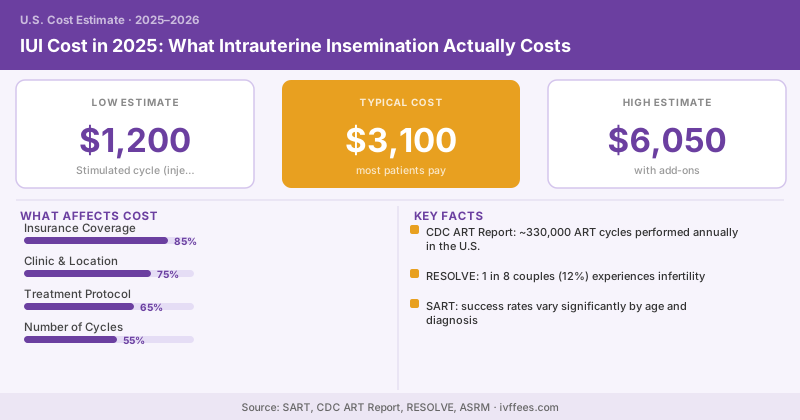
| Stimulated cycle (injectables), total | $1,200 | $3,100 | $6,050 |
When Does IUI Work — and When Doesn’t It?
Success rates for IUI vary dramatically by diagnosis and age. According to SART data, the average live birth rate per IUI cycle is approximately 10–20% for women under 35 with unexplained infertility or mild male factor — comparable to the natural monthly conception rate for healthy couples. That’s not amazing odds, but IUI is inexpensive enough that multiple attempts are financially feasible.
IUI tends to work well for:
- Mild male factor infertility — low motility or count that still produces adequate washed sperm
- Unexplained infertility — couples who haven’t found a specific cause
- Cervical factor — when cervical mucus is hostile to sperm
- Single-parent families and same-sex couples using donor sperm
IUI is generally not recommended — or is less likely to succeed — for:
- Blocked or damaged fallopian tubes — sperm still need to reach the egg
- Significant male factor — very low sperm count or motility
- Advanced maternal age (40+) — lower egg quality reduces all non-IVF odds
- Multiple prior failed IUI cycles — at some point, moving to IVF is more cost-effective
Most reproductive endocrinologists recommend 3 to 6 IUI cycles before proceeding to IVF, depending on age and diagnosis. For women under 35 with unexplained infertility, 3–4 attempts is a reasonable trial. For women 38+, 2–3 cycles may be more appropriate before moving on, given the impact of age on egg quality.
Natural vs. Stimulated IUI: Is the Extra Cost Worth It?
A natural cycle IUI (no medications) is the cheapest option — roughly $650–$1,500 all-in. But success rates are lower.
Adding oral medications like Clomid (clomiphene) or Letrozole (femara) costs very little — $30–$100 for the prescription — and typically increases the number of eggs released to 1–2, modestly improving IUI success rates. Most REs use Letrozole first because it’s better tolerated and produces more favorable endometrial lining.
Injectable gonadotropins produce more follicles (2–4 typically) and higher success rates, but dramatically increase cost ($1,500–$3,000 in medications alone) and risk of twins or higher-order multiples. This approach is less common for routine IUI.
With ovarian stimulation and IUI, the risk of twins is real. Injectable IUI cycles have twin rates of 15–25% compared to roughly 1–2% with natural conception. Twins carry significantly higher risks for both mother and babies, including preterm birth and NICU stays. Discuss multiples risk with your RE before agreeing to an aggressive stimulation protocol.
Using Donor Sperm for IUI
If you’re using donor sperm — for a single parent by choice, same-sex couple, or severe male factor — add the cost of sperm purchase and storage.
Donor sperm from a licensed sperm bank costs $500–$1,200 per vial (IUI-ready washed specimens). Most banks recommend purchasing 2 vials for a cycle as backup. With storage and shipping, plan on $1,200–$2,500 per cycle in sperm costs before the IUI procedure itself.
Leading sperm banks include California Cryobank, Fairfax Cryobank, Seattle Sperm Bank, and GIVF. Pricing, donor selection, and sperm quality vary between banks.
Does Insurance Cover IUI?
In states with fertility insurance mandates, IUI is often among the first covered treatments. It’s considered a “less invasive” option, and many state laws require coverage of IUI before or alongside IVF requirements.
Even without a state mandate, some employer plans cover diagnostic procedures and IUI — particularly for documented male factor infertility. Call your insurance’s fertility case management line and specifically ask: “Does my plan cover intrauterine insemination? If so, how many cycles and what’s my cost-sharing?”
IUI vs. IVF: The Cost-Effectiveness Question
If IUI has a 15% success rate per cycle and IVF has a 45% success rate per cycle (for under-35 women), how do you compare value?
A rough calculation: three IUI cycles at $1,500 each = $4,500 for roughly a 40–45% cumulative chance of pregnancy. One IVF cycle at $18,000 = a 45–50% chance in one attempt.
For younger women with good prognosis, starting with IUI makes economic sense. For women over 38, or those with diagnoses that make IUI unlikely to succeed, skipping to IVF may actually save money by avoiding multiple failed IUI cycles before inevitably moving on.
This is a decision worth making explicitly with your reproductive endocrinologist — not an assumption.
Success rate estimates based on SART 2022–2023 national summary data. IUI procedure costs based on national survey data from RESOLVE and ASRM.