The $15,000 quote you got? That’s probably just the base procedure — before medications, genetic testing, or the second cycle you might need.
IVF is expensive. Most Americans already know that. What they don’t know is why it’s expensive, what that price actually includes, and what the final bill looks like after everything is added up. This guide breaks it down completely.
Estimates are for budgeting only. Actual costs vary by clinic, protocol, and insurance plan details. Medications sold separately unless noted. Get an itemized quote from your fertility clinic.
What the Average IVF Cycle Costs
A single IVF cycle in the United States runs $12,000 to $17,000 for the base procedure. Add fertility medications and you’re typically looking at $15,000 to $25,000 all-in for one attempt.
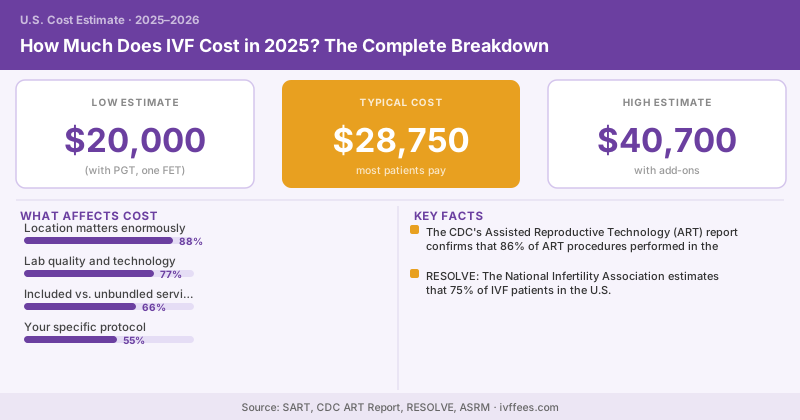
According to SART (Society for Assisted Reproductive Technology), the national average cost per retrieval cycle is approximately $12,400 — but that figure excludes medications, which add $3,000 to $6,000 on average. The CDC’s Assisted Reproductive Technology (ART) report confirms that 86% of ART procedures performed in the U.S. in 2021 involved fresh non-donor eggs, with costs varying dramatically by clinic and region.
| Cost Component | Low End | Typical | High End |
|---|---|---|---|
| Base IVF procedure | $10,000 | $13,500 | $18,000 |
| Fertility medications | $2,500 | $4,500 | $7,000 |
| Embryo monitoring/culture | $1,000 | $1,500 | $2,500 |
| Anesthesia | $500 | $750 | $1,200 |
| PGT-A genetic testing (optional) | $3,000 | $4,500 | $6,000 |
| Frozen embryo transfer (if needed) | $3,000 | $4,000 | $6,000 |
| Total (with PGT, one FET) | $20,000 | $28,750 | $40,700 |
What’s Typically Included in the Base Price
When a clinic quotes you $13,500 for IVF, here’s what that usually covers:
- Monitoring appointments — ultrasounds and blood draws during stimulation (typically 6–10 visits)
- Egg retrieval — the outpatient procedure to collect mature eggs
- Sperm preparation — washing and concentration
- Fertilization and embryo culture — lab work for 5–7 days
- Fresh embryo transfer — placing one or two embryos into the uterus
- Embryo freezing setup — though storage fees are usually separate
What it typically doesn’t include: medications, genetic testing, anesthesia billed separately, embryo storage, and any additional frozen transfers.
Before signing with any clinic, request an itemized quote that includes: medications, anesthesia, lab fees, embryo storage for one year, and a frozen embryo transfer cycle. The sticker price is almost never the real price.
Why IVF Prices Vary So Much
A clinic in Manhattan charges $22,000. A clinic in Phoenix charges $11,500. Same procedure — different price. Here’s why:
Location matters enormously. Clinics in high cost-of-living cities (New York, San Francisco, Boston) charge significantly more than those in the Midwest or Southeast. Some patients travel specifically for lower-cost care — a strategy called “fertility tourism within the U.S.”
Lab quality and technology. Embryology labs with state-of-the-art incubators, time-lapse imaging (EmbryoScope), and advanced culture media charge more. Whether those premium tools improve outcomes depends on the clinic and the patient.
Included vs. unbundled services. Some clinics offer package pricing that wraps medications, unlimited monitoring, and one FET into a single fee. Others unbundle everything and bill line-by-line.
Your specific protocol. If you need a longer stimulation period, more medications, a mock embryo transfer, or additional diagnostics, costs rise accordingly.
The Multi-Cycle Reality
Here’s the number that often catches couples off guard: most patients don’t get pregnant on their first IVF cycle. According to CDC data, the live birth rate per egg retrieval for women under 35 is approximately 49% — meaning about half of those under-35 patients will need more than one retrieval to take a baby home.
For women 35–37, the rate drops to around 35%. For women 40–42, it’s roughly 16%.
Many clinics advertise per-cycle success rates, not cumulative rates. A 40% success rate per cycle still means a significant chance of needing 2 or 3 cycles. Plan your budget for at least two full attempts before starting.
Multi-cycle or “shared risk” packages address this. You pay $20,000–$30,000 upfront for multiple retrieval cycles, with a partial refund if you don’t deliver a live baby. These programs aren’t right for everyone (they can be a bad deal if you get pregnant on cycle one), but they do provide cost predictability.
Medications: The Biggest Hidden Cost
Fertility medications deserve their own budget line because they’re variable and can blindside you.
A typical stimulation protocol uses injectable gonadotropins (FSH, LH, or both) for 8–14 days. Brand-name medications like Gonal-F, Follistim, and Menopur retail for $3,500–$7,000 per cycle. Biosimilar options (Rekovelle, Omnitrope used off-label) can cut this to $2,000–$3,500.
Some strategies to lower medication costs:
- Specialty pharmacies (MDR, FertilityRx, Koala Meds) often beat retail pharmacy prices by 20–40%
- Medication-sharing programs — some clinics run programs where unused meds are donated to other patients
- International pharmacies — legal to import for personal use, significantly cheaper, though requires research
Does Insurance Cover IVF?
It depends entirely on your state and your employer. As of 2025, 21 states have enacted some form of fertility insurance mandate, but the requirements vary widely. Some require insurers to cover IVF; others only require coverage of diagnosis.
States with strong IVF coverage mandates include Illinois, Massachusetts, New Jersey, New York, and Connecticut. If you live in one of these states and have qualifying employer-sponsored insurance, you may have significant coverage.
If you’re self-employed, on an ACA marketplace plan, or in a state without mandates, you’re almost certainly paying out of pocket. RESOLVE: The National Infertility Association estimates that 75% of IVF patients in the U.S. pay for treatment entirely out of pocket.
Even with insurance, coverage limits matter. A plan might cover one retrieval cycle per lifetime, or cap fertility benefits at $15,000. Read the fine print.
Financing IVF
For those paying out of pocket, several financing routes exist:
Medical financing: CareCredit and Prosper Healthcare Lending offer 0% promotional periods (12–24 months) for qualified applicants. After the promotional period, interest rates spike to 26%+, so this only works if you can repay within the window.
Clinic financing: Many practices partner with lenders or offer in-house payment plans. Rates vary from 0% (rare) to 12%+ over 24–60 months.
HSA/FSA: If your employer offers a Health Savings Account or Flexible Spending Account, IVF costs are qualified medical expenses. Contribute the maximum if you’re planning a cycle.
Grants: Organizations like Baby Quest Foundation, Fertility Within Reach, and the Cade Foundation offer grants ranging from $2,000 to $15,000. Applications are competitive and income-limited, but worth pursuing.
Questions to Ask Every Clinic Before Committing
- What exactly is included in the quoted price?
- What are your clinic’s live birth rates for my age group, by year?
- What medications do you typically prescribe, and what’s the estimated cost?
- Do you offer multi-cycle or shared-risk packages?
- What does a frozen embryo transfer cost if my fresh transfer doesn’t work?
- Are there any additional fees for ICSI, assisted hatching, or extended culture?
IVF is one of the most significant financial decisions a family will make. The clinics you’re considering should answer these questions clearly and without hesitation. If a clinic is evasive about pricing, that tells you something too.
The Bottom Line
Budget $15,000–$25,000 for a first IVF cycle including medications. If you need genetic testing, a frozen transfer, or additional cycles, plan for $30,000–$60,000 over your full IVF journey. These numbers are hard to read, but having a realistic picture from the start is far better than being surprised mid-treatment.
Cost estimates based on SART 2023 data, CDC ART National Summary Report 2021, and clinic survey data compiled by RESOLVE. Individual costs vary by clinic, location, insurance coverage, and treatment protocol.