3 things most people don’t know before paying for a shared-risk IVF program: the upfront cost is much higher than a single cycle, you have to qualify medically, and the refund terms have fine print that matters enormously.
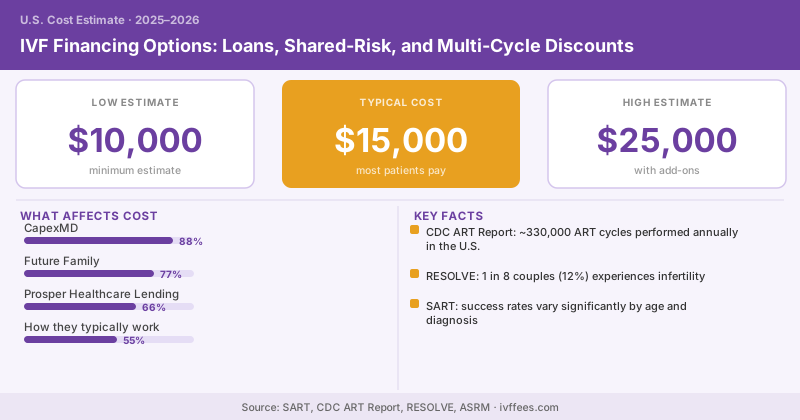
IVF financing has evolved significantly. Today there are more options than ever for managing the $15,000–$30,000 cost of a single cycle — or the $40,000–$80,000 some patients end up spending across multiple attempts. This guide covers every major financing mechanism, what they cost, and what to watch out for.
The Full Range of IVF Financing Options
| Financing Type | Typical Upfront Cost | Key Benefit | Key Risk |
|---|---|---|---|
| Single-cycle pay-as-you-go | $15,000–$25,000 | No premium, maximum flexibility | Full cost if multiple cycles needed |
| Multi-cycle bundle (2–3 cycles) | $25,000–$45,000 | Per-cycle discount 15–30% | May not need all cycles |
| Shared-risk/refund program | $20,000–$40,000 | Refund if no baby | Higher cost, strict qualification |
| Fertility loan (CapexMD, etc.) | $10,000–$40,000 | Flexible payment terms | Interest adds 8–20% total cost |
| Personal loan/HELOC | $10,000–$50,000 | Lower interest if good credit | Debt risk, collateral risk |
| Employer benefit coverage | $0–$20,000 | May cover significant portion | Job-dependent, not universally available |
Medical Loans for IVF
Specialized fertility lenders like CapexMD, Prosper Healthcare Lending, and Future Family offer personal loans specifically for fertility treatment.
CapexMD: Offers loans up to $100,000 with terms of 24–84 months. Interest rates typically run 6–20% APR depending on credit. They work directly with fertility clinics and can often fund within 1–2 weeks.
Future Family: Combines financing with care navigation. Monthly payment plans start around $300–$600/month. They also offer price transparency tools to compare clinic costs in your area.
Prosper Healthcare Lending: General medical lender that covers fertility. Rates from 5.99% to 29.99% APR, terms up to 60 months.
The real cost of borrowing: a $20,000 loan at 15% APR over 48 months adds about $6,400 in interest, bringing your total to ~$26,400. That’s meaningful but often manageable compared to paying it all upfront.
Always compare: APR (not just monthly payment), total cost over the loan term, prepayment penalties, and whether the lender works directly with your clinic (simplifies the transaction). A lower monthly payment often means more total interest — calculate the full-term cost before signing anything.
Multi-Cycle Bundle Discounts
Many fertility clinics offer package pricing for patients committing to multiple cycles upfront. A typical 2-cycle bundle might run $30,000–$35,000 versus $40,000–$50,000 for two cycles separately — a savings of 15–25%.
The catch: if you succeed on the first cycle, you’ve paid for cycles you didn’t need (though some programs will credit you toward other services or refund the unused cycle cost). Ask about the terms before committing.
Multi-cycle packages often exclude medications (which are purchased separately at $3,000–$6,000 per cycle) and may not include genetic testing. Read what’s included carefully.
Shared-Risk (Refund) Programs
These programs — sometimes called “IVF guarantee” or “money-back guarantee” programs — charge a higher upfront premium in exchange for a full or partial refund if you don’t achieve a live birth after a defined number of cycles.
How they typically work:
- Pay $20,000–$35,000 upfront (instead of $15,000 for one cycle)
- Clinic provides up to 2–4 retrieval cycles and all associated frozen transfers
- If no live birth, you receive a refund of 70–100% of the program fee
Who qualifies: This is the critical piece. Shared-risk programs carefully screen applicants. They accept patients with good prognoses — typically women under 40 with good ovarian reserve. If your success probability is already high, the insurance premium isn’t worth it. If your probability is low, the clinic may not accept you at all.
According to a RESOLVE survey, shared-risk programs charge an average 60–80% premium over the cost of a single cycle. For a woman with a 45% per-cycle success rate who would likely succeed in 1–2 cycles, a shared-risk program often costs more in total than self-funding. For a woman with a 25% per-cycle rate who may need 3–4 cycles, it can represent real protection.
Read shared-risk program contracts carefully before signing. “Refund” terms frequently exclude: medications, PGT testing, anesthesia, and certain monitoring fees — which can be $5,000–$10,000 per cycle. The refund may be on the “program fee” only, not your total out-of-pocket cost. Ask for a complete itemized accounting of what is and isn’t refunded.
Employer Fertility Benefits
This is one of the most underutilized resources. A growing number of large employers offer fertility benefits as part of their health plans — including IVF coverage.
According to Mercer’s 2023 National Survey of Employer-Sponsored Health Plans, 42% of large employers (500+ employees) now offer IVF benefits, up from 30% in 2019. Companies like Google, Apple, Amazon, Microsoft, Meta, and most major financial services firms offer $20,000–$50,000 lifetime fertility benefits.
If you haven’t checked your employee benefits package recently, check now. Even if IVF isn’t covered, some plans cover medications, diagnostic testing, or embryo storage separately.
HSA and FSA for IVF
Health Savings Accounts (HSAs) and Flexible Spending Accounts (FSAs) can cover most IVF-related expenses as qualified medical expenses. This lets you pay with pre-tax dollars — effectively reducing your cost by your marginal tax rate.
For someone in the 22% federal bracket plus state taxes, HSA/FSA funding reduces effective IVF cost by 28–35%. On a $20,000 cycle, that’s $5,600–$7,000 in real savings.
The limitation is contribution limits: HSA max in 2025 is $4,300 (individual) or $8,550 (family). FSA max is $3,300. These can help cover medications, monitoring, and testing but don’t fund an entire cycle.
The Bottom Line
There’s no single best IVF financing option — the right choice depends on your success probability, how much you can pay upfront, your credit score, and your employer benefits. The hierarchy most financial advisors suggest: max out employer benefits first, then HSA/FSA, then consider multi-cycle bundles if you expect needing multiple cycles, and explore shared-risk only if you’ve run the math on your specific success probability. Medical loans are a valid bridge when cash flow is the constraint.